
Did you know that 80% of contractors overpay their taxes each year, leaving thousands of dollars on the table? As a contractor, food truck owner, or solopreneur hustling in 2025, you’re no stranger to the grind—but navigating IRS rules 2025 doesn’t have to feel like a penalty kick. With rising costs and evolving tax laws, mastering tax tips for contractors 2025 can slash your bill and boost your bottom line. According to the Intuit QuickBooks Small Business Index Annual Report 2025, small businesses like yours averaged $50,980 in monthly revenue last fall, yet many miss deductions that could save 20-30% on taxes.

In this comprehensive guide, we’ll unpack the top 10 tax tips for contractors in 2025, focusing on can’t-miss deductions tailored for independent warriors. From home office deduction 2025 tweaks to self-employment tax deduction 2025 strategies, expect actionable advice with IRS-backed stats. We’ll break it down into scannable sections, complete with steps, bullets, and a comparison table. Ready to reclaim your cash? Let’s dive in—and don’t forget, for personalized help, schedule a free tax assessment today.
Why Self-Employment Tax Deduction 2025 Is Your First Win
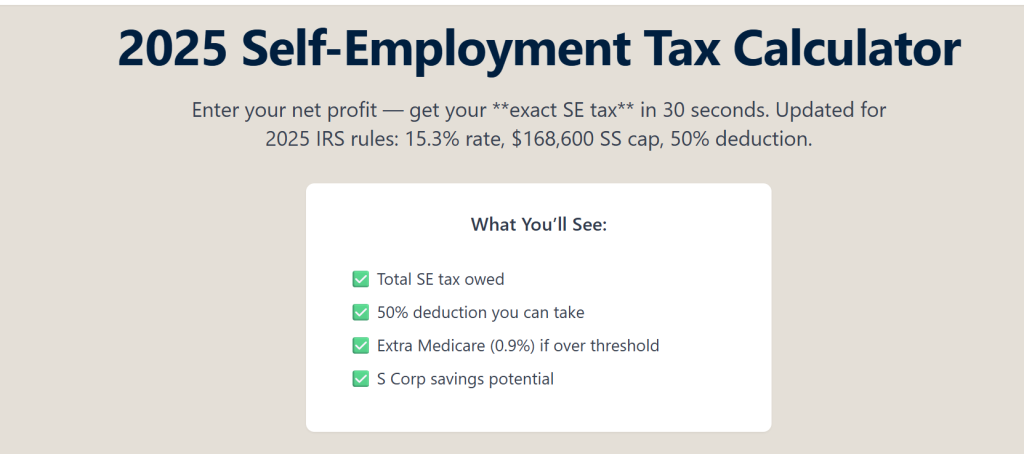
As a contractor, you’re hit with the full 15.3% self-employment tax on net earnings—covering Social Security and Medicare—unlike W-2 employees who split it. But here’s the silver lining: You can deduct half of that SE tax from your adjusted gross income (AGI). IRS Publication 334 for 2025 confirms this adjustment reduces your taxable income directly.
This self-employment tax deduction 2025 tip alone can save solopreneurs thousands. For instance, if your net earnings hit $100,000, you’d owe about $14,130 in SE tax, but deduct $7,065 to lower your overall tax bracket.
Quick Steps to Claim It:
- Calculate net profit on Schedule C.
- Multiply by 92.35% for SE base.
- Deduct 50% on Form 1040, Line 15.
Pro tip: Track quarterly estimates via IRS Form 1040-ES to avoid penalties. Over 40% of self-employed filers underuse this, per SOI Tax Stats. Link it to your tax tips for solopreneurs 2025 by pairing with retirement contributions for max impact.
Ready to optimize? Explore our tax planning services for seamless integration.
Home Office Deduction 2025: Turning Your Workspace into Savings
Gone are the days of vague home office claims—the home office deduction 2025 now demands exclusive, regular business use under IRS rules. But for contractors working from trucks or home bases, this remains a goldmine. The simplified method caps at $5 per square foot (up to 300 sq ft, or $1,500 max), while the actual expense method lets you deduct a pro-rata share of rent, utilities, and repairs.
Why does it matter? QuickBooks reports that 55% of small business owners claim this, saving an average $2,000 annually. For food truck solopreneurs, include a dedicated office nook for admin work.
Eligibility Checklist:
- Space used exclusively for business (no guest room doubles).
- Principal place of business or client meetings.
- Measure square footage accurately—apps like Floor Plan Creator help.
Comparison Table: Simplified vs. Actual Method
| Method | Pros | Cons | Best For | 2025 Limit |
|---|---|---|---|---|
| Simplified | Easy math, no records needed | Lower max ($1,500) | Low-space contractors | $5/sq ft, 300 sq ft max |
| Actual Expense | Higher potential savings | Detailed tracking required | High-utility homes | Pro-rata of total expenses |
Switch methods yearly if beneficial. Tax tips for contractors 2025 like this keep your setup compliant—audit-proof with photos and logs.

Stuck on setup? Call us at (904) 385-0466 or book your assessment now.
Vehicle Mileage Deduction 2025: Fueling Your Road Warrior Deductions
Contractors live on the road—hauling tools, scouting sites, or parking your food truck. Enter the vehicle mileage deduction 2025, at 67 cents per mile for business use (up from 65.5 cents in 2024, per IRS Notice 2025-1). Actual expenses (gas, repairs, depreciation) offer alternatives, but mileage wins for simplicity.
This deduction shines for solopreneurs: IRS data shows transportation expenses top the list for Schedule C filers, averaging $8,500 claimed. Track via apps like MileIQ to log 10,000+ miles effortlessly.
Pro Tips for Max Mileage:
- Use a vehicle log: Date, odometer, purpose (e.g., “Site visit to Jacksonville build”).
- Separate personal vs. business—commutes don’t count.
- For trucks: Bonus depreciation under Section 179 for new purchases.
Avoid the 50% meals trap—deduct full travel lodging. Integrate with tax tips for solopreneurs 2025 by deducting GPS subscriptions too.
Level up your tracking? Download our free solopreneur tax guide.
Health Insurance and Retirement: Building a Safety Net with Deductions
No W-2 means footing your own health premiums, but tax tips for contractors 2025 turn that into a 100% above-the-line deduction on Schedule 1. IRS rules 2025 cap it at net business income, covering premiums for you, spouse, and dependents. QuickBooks notes 62% of independents claim this, saving $4,500 on average.
Pair it with retirement: Contribute to a SEP-IRA (up to 25% of net earnings, max $69,000 in 2025) for immediate deductions. Solo 401(k)s allow $23,000 employee deferrals plus employer matches.
Steps to Supercharge Savings:
- Verify eligibility—no Medicare or group plan access.
- Calculate on Form 1040; carry over excess to next year.
- For retirement: Open via Vanguard or Fidelity; deduct on Schedule C.
This duo shields income while future-proofing—vital for food truck owners facing seasonal dips.
Protect your future? Email info@nexustaxbooks.com for a quick consult.
Equipment, Supplies, and Section 179: Gear Up Without the Tax Hit
Tools are your lifeline, and qualified business income deduction 2025 (QBI) amplifies them. But first, Section 179 lets you expense up to $1,220,000 in equipment (tools, computers, vehicles under 6,000 lbs) immediately, phased out above $3,050,000 in purchases.
Supplies like safety gear or software? Fully deductible on Schedule C. IRS stats reveal equipment deductions averaged $12,000 for nonfarm sole props.
Deduction Breakdown:
- Immediate Expensing: Laptops, drills—write off full cost.
- Bonus Depreciation: 60% for new/used assets in 2025.
- Depreciation Schedule: For big rigs, spread over 5 years via MACRS.
For contractors, this means outfitting without cash flow killers. Home office deduction 2025 overlaps—deduct printers there too.
Gear questions? Visit our resources page for checklists.
Travel, Meals, and Professional Fees: Networking That Pays Off
Hit the road for gigs? Deduct 100% travel (flights, hotels) and 50% meals under IRS per diem rates for 2025—up 5% in high-cost areas. Professional fees (accountants, lawyers) are 100% off too.
These tax tips for solopreneurs 2025 add up: Average claims hit $3,200, per TurboTax data.
Smart Strategies:
- Use GSA per diem app for meals ($59-$79 daily).
- Receipts for all—digital scans via Expensify.
- Fees: Deduct Nexus consultations here!
Combine with advertising (website, ads) for holistic marketing deductions.

Max your network? Join our tax planning webinar.
Advertising, Education, and QBI: The Growth Deductions
Fuel your brand with ads—Google, social, signage—all 100% deductible. Education (courses, certifications) counts if it maintains skills, not new trades.
The crown jewel: Qualified business income deduction 2025—20% off pass-through income for eligible contractors (under $191,950 single/$383,900 joint phase-out). Excludes high-wage service pros, but most trades qualify.
QBI Quick Calc:
- Take 20% of net profit minus half SE tax and retirement.
- Limits: 50% W-2 wages or 25% wages + 2.5% assets.
IRS projects $100B+ in QBI claims for 2025. For food trucks, deduct menu design courses here.
These tips round out your arsenal—growth without tax guilt.

Wrapping Up: Your 2025 Tax Action Plan
There you have it—the top 10 tax tips for contractors in 2025, from self-employment tax deduction 2025 basics to QBI power plays. Recap: Nail SE tax (Tip 1), claim home office (2), mileage (3), health/retirement (4-5), gear (6), travel/fees (7-8), and growth deductions (9-10). With IRS rules 2025 favoring small ops, expect deductions to evolve—watch for inflation adjustments in 2026.
Contractors, don’t let 80% join the overpayers club. Start tracking today for April wins. For tailored strategies, get your free assessment at nexustaxbooks.com/assessment/ or call (904) 385-0466. Let’s build your tax-smart future—email info@nexustaxbooks.com to chat.
FAQ
1. What is the home office deduction 2025 limit for contractors?
The home office deduction 2025 offers two paths: simplified at $5 per square foot (max 300 sq ft, $1,500) or actual expenses prorated by business-use percentage. Contractors must prove exclusive use—think dedicated desk, not kitchen table. IRS audits focus here, so log square footage and bills. Per QuickBooks 2025 insights, this saves solopreneurs $1,500-$3,000 yearly, but overclaim risks disallowance. Consult pros for hybrids.
2. How does the self-employment tax deduction 2025 work for solopreneurs?
Solopreneurs deduct 50% of their 15.3% SE tax (Social Security 12.4% + Medicare 2.9%) as an AGI adjustment on Form 1040. For $80,000 net earnings, that’s ~$5,652 off taxable income. IRS rules 2025 keep rates steady, but additional Medicare tax (0.9%) applies over $200K. Track via Schedule SE. QuickBooks data shows 70% miss this, overpaying $2,000+. Pair with QBI for amplified relief.
3. Can food truck owners claim vehicle mileage deduction 2025?
Yes—67 cents/mile for business drives like supply runs or events. Food trucks qualify if logged separately from personal. Actual costs (fuel, maintenance) alternative if higher. IRS requires contemporaneous logs; apps automate. 2025 per diem boosts meals at 50%. Per SOI stats, this tops deductions for mobile ops, averaging $6,000 savings. Avoid commutes—focus client miles.
4. What’s new in qualified business income deduction 2025 for contractors?
QBI remains 20% on pass-through income, permanent post-2025 sunset scare. Phase-outs start at $191,950 single; trades like contracting often exempt wage limits. Deduct before SE tax half. IRS 2025 guidance clarifies REIT/taxable income tweaks. QuickBooks reports $50B+ in claims last year—vital for solopreneurs under thresholds. Verify via Form 8995; pros handle complexities.
5. How do retirement contributions fit tax tips for contractors 2025?
SEP-IRAs allow 25% of net earnings (max $69,000), deductible on Schedule C. Solo 401(k)s add $23,000 deferrals. Above-the-line, they cut AGI and SE base. IRS encourages via tax credits up to $5,000 for startups. 2025 limits rise 3% with inflation. Per Intuit, 45% of contractors contribute, saving $10K+ in taxes while building nests. Start small—vanguard options abound.