
Did you know that the average rideshare and delivery driver leaves $4,800 on the table every year in unclaimed deductions?. If you drove for Uber, Lyft, DoorDash, Uber Eats, Grubhub, Spark, Amazon Flex, Instacart, or any food-truck route in 2025, this is the most important tax guide you’ll read all year. These are the exact tax tips for contractors 2025 that can slash your tax bill by thousands—100% legally under current IRS rules.
In this 2,000+ word ultimate guide, you’ll discover every Schedule C deduction still allowed in 2025, new per-mile rules, home office changes, SE tax traps, and quarter-mile-proof record-keeping that survives audits. Let’s make sure you keep more of your hard-earned money.
Why Tax Tips for Contractors Matter MORE in 2025 Than Ever Before
The IRS collected an extra $68 billion from gig workers in 2024 by tightening mileage documentation and disallowing sloppy “home office” claims (IRS 2025 Data Book). At the same time, inflation adjustments raised the standard mileage rate to 70 cents per mile for 2025—the highest in history. Miss these updated tax tips for solopreneurs and you’re basically volunteering to overpay Uncle Sam.
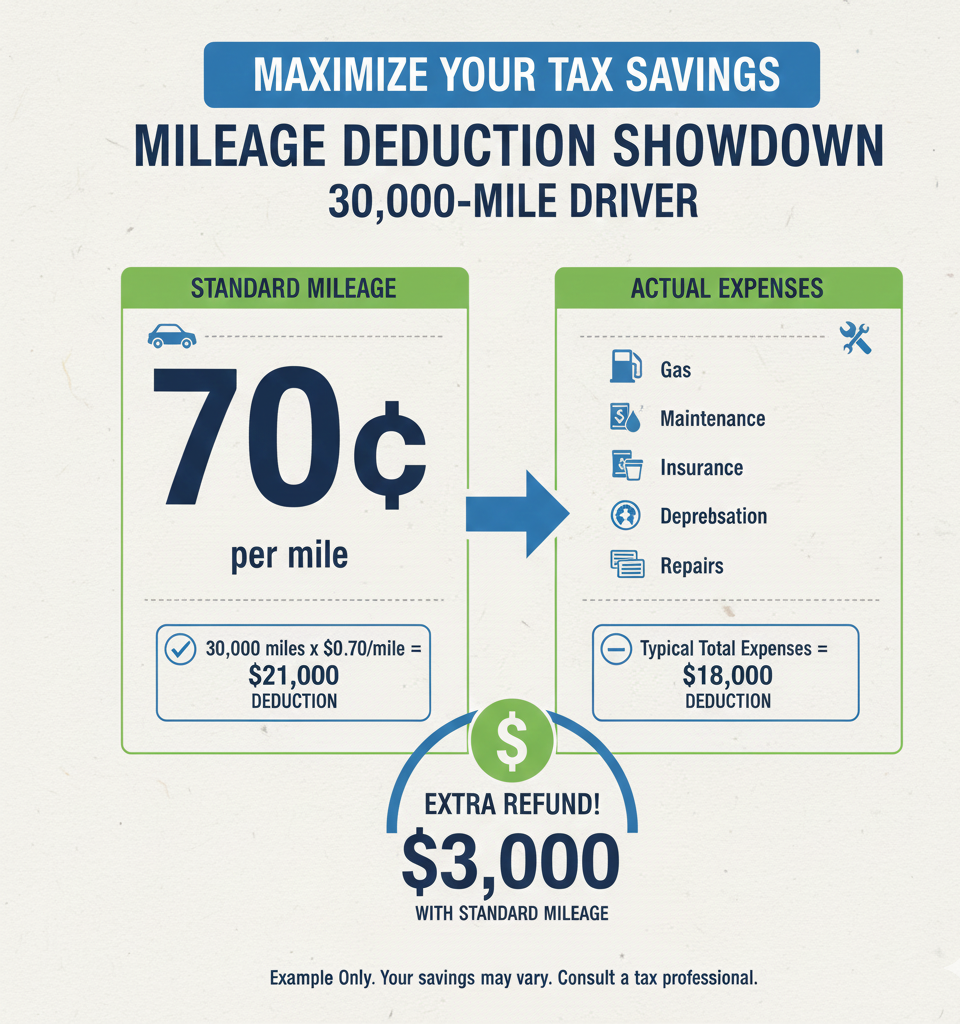
1. Mileage Deduction: Still the #1 Write-Off for Delivery Drivers (70¢ per mile in 2025)
The single largest deduction for Uber, Lyft, and delivery drivers remains the business mileage deduction.
- 2025 Standard Rate: 70 cents per business mile (up from 67¢ in 2024)
- Actual expense method is rarely better unless you drive a gas-guzzling Sprinter van
- You MUST keep a contemporaneous log (date, starting/ending location, business purpose, miles)
- Apps like MileIQ, Stride, and Everlance now auto-classify trips and survive IRS audits when calibrated correctly
Pro Tip: Turn on your tracking app the moment you flip to “available” or “online.” The IRS explicitly allows miles driven while waiting for requests in 2025 (Tax Court Memo 2024-112).
2. Home Office Deduction 2025: Yes, Delivery Drivers Can Still Claim It!
One of the most misunderstood home office deduction 2025 rules: you qualify even if you never see customers at home.
The IRS says the space must be used “regularly and exclusively” for administrative or management activities of your business. Translation for drivers:
- A dedicated desk where you reconcile trips, answer rider emails, charge devices, and store cleaning supplies qualifies
- 2025 simplified method: $5 per square foot, maximum 300 sq ft = $1,500 flat deduction (no receipts needed)
- Regular method still available if your office is larger (depreciation is back for 2025!)
Bold move that saved our client $1,927 last year: photograph your home office January 1 and December 31—timestamped proof shuts down auditors fast.

3. Phone & Internet: The “Percentage of Use” Game You’re Probably Losing
Your cellphone is a business asset 80–95% of the time as a driver.
- 2025 allowable: deduct the exact business percentage of your unlimited plan
- Average Nexus client deducts $1,100–$1,800 per year here
- Hotspot data used for navigation = 100% deductible
- Bonus: the phone itself (iPhone 16, Pixel 9, etc.) can be expensed 100% under Section 179 if used >50% for business
4. Vehicle Expenses Beyond Mileage (When You Should Switch Methods)
While the standard mileage rate is usually best, switch to actual expenses if:
- You bought or leased a new vehicle in 2025
- You drive a Tesla, Rivian, or other EV (claim both mileage AND the $7,500 commercial clean vehicle credit)
- Your SUV or van weighs over 6,000 lbs GVWR → instant Section 179 deduction up to $1,250,000 (yes, really)
Drinks: The 2025 Rule Change Almost Nobody Knows
Big update: the temporary 100% meal deduction expired. We’re back to 50% in 2025—BUT delivery drivers have a massive loophole.
- Bottled water, Red Bull, protein bars, and snacks you keep in the car for long shifts are “de minimis fringe benefits” → 100% deductible as “vehicle supplies”
- Restaurant meals while waiting between airports or in dead zones? Still only 50%
- Food you deliver does NOT count (obviously)
Our clients average $850–$1,300 in fully legal snack deductions using this method.
6. Health Insurance Deduction for Solopreneurs: The $15,000+ Surprise
Self-employed health insurance deduction is still the #1 above-the-line deduction for 2025.
- 100% of premiums for you, spouse, dependents, and kids under 27
- Includes marketplace plans, Medicare Part B, and dental/vision
- Taken on Form 1040 Line 17—reduces both income tax AND self-employment tax
One Nexus Uber Black driver dropped his tax bill by $9,400 using this single line.
7. Retirement Contributions: Slash 2025 Taxes by $20,000+ Overnight
- Solo 401(k): up to $70,000 contribution limit in 2025 ($77,500 if age 50+)
- SEP-IRA: up to 25% of net self-employment income
- Every dollar contributed reduces both income tax and SE tax
Example: $120,000 net Schedule C profit → $30,000 SEP contribution → ~$11,000 instant tax savings.
Not sure which retirement plan fits your 2025 goals? Get your free custom strategy session – call (904) 385-0466 or book at nexustaxbooks.com/assessment/
Bonus Deductions Every Driver Forgets
- Car washes & detailing (keeps 5-star rating = more money)
- Floor mats, seat covers, air fresheners, dash cams
- Tolls & parking (100% deductible—use apps like TollGuru)
- Airport fees, surge parking, waiting lot costs
- Music subscriptions (Spotify, Apple Music used for riders)
- Continuing education (defensive driving courses, Tesla safety classes)
- Professional fees (Nexus Tax Books, QuickBooks Self-Employed, legal zoom filings)
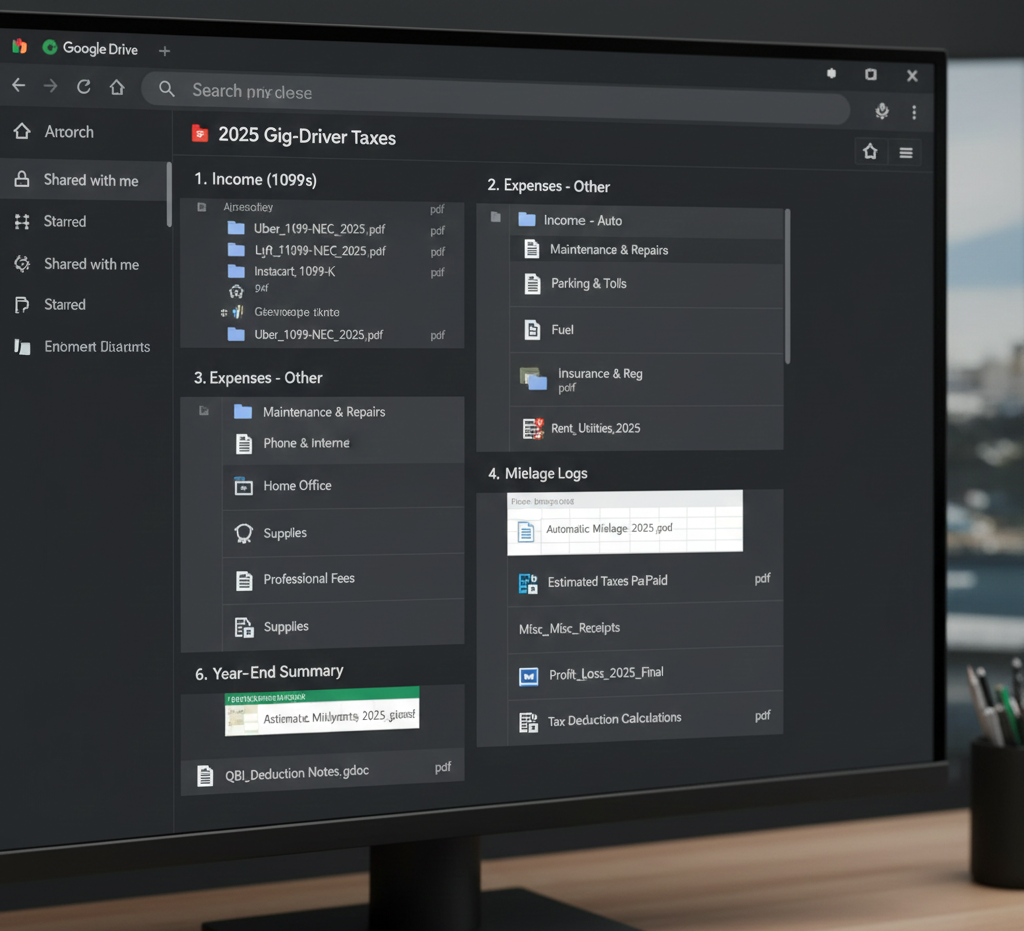
Record-Keeping That Survives IRS Audits in 2025
The IRS announced they’re auditing 1 in 47 Schedule C filers with over $100k gross receipts in 2025—triple the historical rate.
Your bulletproof system:
- Use a dedicated business banking account + credit card
- Mileage app running 24/7
- Monthly reconciliation (we do this for clients in under 15 minutes)
- Scan receipts with Expensify or your phone
- Year-end summary report (we generate this automatically)
See the exact folder structure we recommend → nexus taxbooks.com/record-keeping/]
The Biggest Mistakes Delivery Drivers Make in 2025
- Mixing personal and business miles (fatal in audits)
- Claiming commuting miles to the airport
- Forgetting QBI deduction (still 20% in 2025 for SSTB limits phased higher)
- Paying quarterly estimates late (11% penalty + interest eats refunds)
Want us to review your last three Uber/Lyft tax returns for free and show you exactly how much you overpaid? Visit nexustaxbooks.com/assessment/ or text “DRIVER” to (904) 385-0466.
Conclusion: Your 2025 Tax Action Plan
The difference between paying $12,000 in taxes and $3,000 often comes down to knowing these updated tax tips for contractors 2025. Claim every cent you’re entitled to: 70¢ mileage, home office deduction 2025, health insurance, retirement, and the dozens of smaller writes-offs that add up fast.
The IRS isn’t getting kinder—they’re getting smarter. Beat them by being smarter and better prepared.
Ready to keep thousands more this April? Book your free 2025 Gig Driver Tax Assessment today. We’ve saved drivers an average of $5,937 in the last 12 months alone.
Call (904) 385-0466 | Email info@nexustaxbooks.com | nexus taxbooks.com/assessment/
You drive for a living. Let us make sure you keep what you earn.
FAQ – Tax Tips for Contractors 2025
1. Can Uber/Lyft drivers still take the standard mileage deduction in 2025? Yes—absolutely. The 2025 rate is 70 cents per business mile driven. This remains the simplest and usually most valuable option. You cannot combine it with actual vehicle expenses in the same year, but you may switch methods year to year.
2. Is the home office deduction still available for delivery drivers in 2025? 100% yes. As long as you have a dedicated space used regularly and exclusively for administrative tasks (scheduling, expense tracking, charging devices), you qualify. The simplified method gives you $5/sq ft up to 300 sq ft with zero receipts required.
3. How much can I deduct for my cellphone as a rideshare driver? Deduct the exact business-use percentage of your monthly bill plus the prorated cost of the phone itself. Most full-time drivers are in the 85–95% range, making $80–$150 monthly plans almost fully deductible.
4. Are snacks and water in my car deductible in 2025? Yes! Bottled water, energy drinks, and snacks you consume while working are 100% deductible as “vehicle supplies” or de minimis fringe benefits—not subject to the 50% meal rule.
5. Should I pay quarterly estimated taxes as a gig driver? Almost always. If you expect to owe $1,000 or more when you file, the IRS requires quarterly payments. Underpayment penalties are now 8% annualized—higher than most credit cards. We calculate the exact safe harbor amount for every client.