
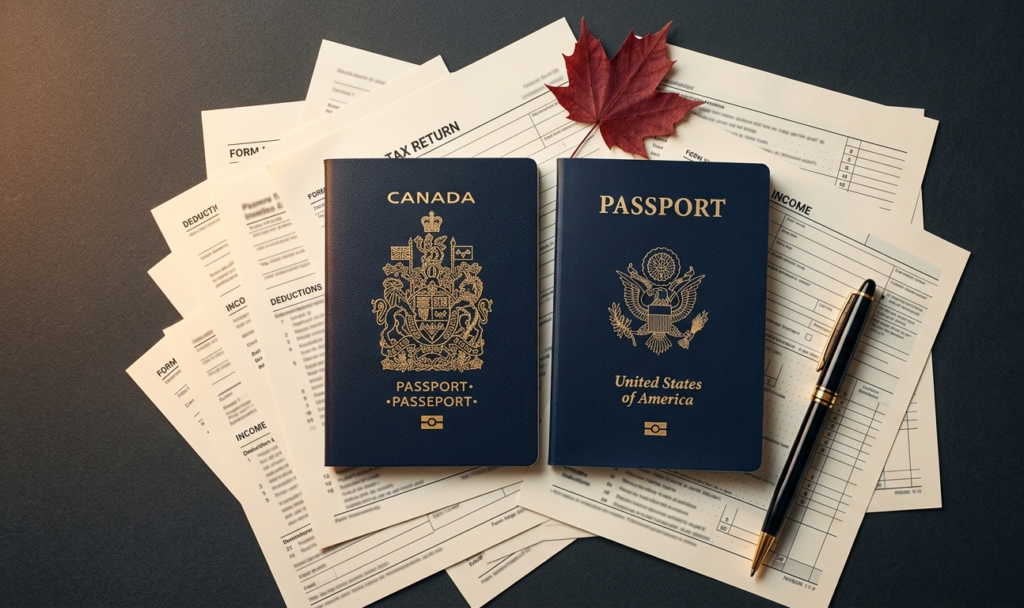
As a Canadian Living in the US,
Do I Have to File US Taxes?
The honest, plain-English answer to a question that confuses even experienced accountants — and exactly what applies to your situation.
Yes, in most cases. If you earn income in the US or spend enough time there to meet the Substantial Presence Test, you must file a US tax return. Canadians file either Form 1040 (resident) or Form 1040-NR (non-resident) depending on how long they’ve been in the US. The US-Canada Tax Treaty prevents double taxation — but only if you actively claim it.
“If you’re Canadian and you’ve moved to the US — even temporarily — the US tax system probably feels overwhelming. Do you file in both countries? What is a 1040-NR? Will you be taxed twice? These are the questions we answer every day, and we’re going to walk you through exactly what applies to your situation.”
The short answer is: your filing obligation depends entirely on how the IRS classifies you — and that classification is based on time spent in the US, not on your immigration status or citizenship. A Canadian on a work visa for three years may owe taxes exactly like a US citizen. A Canadian who worked in the US for two months on a project may only owe taxes on that specific income. Let’s break it down precisely.
Residency Status Determines Everything
The IRS doesn’t care about your Canadian passport. For US tax purposes, what matters is a single question: are you a Resident Alien, a Non-Resident Alien, or a Dual-Status Alien? These three classifications determine which form you file, what income is taxable, and what deductions you can claim.
Canadians in the US are classified as resident aliens, non-resident aliens, or dual-status aliens — not based on citizenship, but on how long they’ve been present in the US. Each status requires a different tax form and has different rules.
| Status | Who Qualifies | Tax Form | What’s Taxed | Complexity |
|---|---|---|---|---|
| Resident Alien | Green card holder OR met Substantial Presence Test (183-day rule) | Form 1040 — same as US citizens | Worldwide income — US and Canadian sources | Standard |
| Non-Resident Alien | In the US for limited time; did NOT meet Substantial Presence Test | Form 1040-NR | US-source income only | Moderate |
| Dual-Status | Changed status mid-year (e.g., arrived from Canada and later met SPT) | Form 1040 + 1040-NR statement | Split — NR rules for part of year, resident rules for the rest | Most Complex |
Resident Alien: You’re Treated Like a US Citizen for Taxes
If you hold a Green Card or have lived in the US long enough to meet the Substantial Presence Test, you are a resident alien and file Form 1040 — the same return US citizens file. You are taxed on your worldwide income, including your Canadian pension, Canadian rental properties, and any Canadian bank interest. You can, however, claim a Foreign Tax Credit for taxes already paid to Canada to avoid paying twice.
Non-Resident Alien: Only US Income Is Taxed
If you were in the US for a limited time and did not meet the Substantial Presence Test, you are a non-resident alien and file Form 1040-NR. Only your US-source income is taxable — your Canadian salary, Canadian investments, and Canadian property income are generally outside the IRS’s reach. This is the most common situation for Canadians who cross the border for short-term work, border commuters, and seasonal workers.
Canadians who live in Canada and commute daily or weekly into the US for work are typically non-resident aliens. They owe US taxes only on their US wages — not on any Canadian-source income. The US-Canada Treaty contains specific provisions for cross-border commuters.
What Is the 183-Day Rule for Canadians?
The 183-day rule uses a 3-year weighted formula: all days in the current year + 1/3 of days last year + 1/6 of days two years ago. If the total reaches 183, you are a US tax resident and must file Form 1040.
The Substantial Presence Test (SPT) is the IRS’s formula for determining whether a non-citizen has been in the US long enough to be taxed as a resident. It’s not simply “did you spend 183 days this year” — it uses a three-year weighted calculation that catches people who spend less than 183 days per year but have been a regular presence in the US.
Weighted total: 120 + (120 × ⅓) + (120 × ⅙) = 120 + 40 + 20 = 180 days → Non-Resident.
If they work just 5 more days in 2024 (125 days): 125 + 40 + 20 = 185 days → US Resident.
Days That Don’t Count Toward the Test
Not every day you set foot in the US counts. The following are excluded from the Substantial Presence Test calculation:
- Days you were unable to leave due to a medical condition that arose while in the US
- Days you were in transit between two foreign countries and spent fewer than 24 hours in the US
- Days you commuted to work in the US from Canada (if you regularly commute from a Canadian residence)
- Days you were an exempt individual (F-1, J-1, and certain diplomatic visas — not typically applicable to Canadians)
Even if you technically meet the Substantial Presence Test, you may be able to claim the Closer Connection Exception (Form 8840) if you maintained a closer connection to Canada than to the US. This requires your tax home to be in Canada and filing Form 8840 by June 15. Many Canadians who split time between countries qualify and never file this form.
The US-Canada Tax Treaty — Your Protection Against Double Taxation
The Convention Between Canada and the United States of America with Respect to Taxes on Income and Capital — most people just call it the US-Canada Tax Treaty — is one of the most comprehensive bilateral tax agreements in the world. It exists specifically to prevent Canadians and Americans from being taxed twice on the same income.
Not if you claim treaty benefits correctly. The US-Canada Tax Treaty allows a Foreign Tax Credit — taxes paid in Canada reduce what you owe in the US. But treaty benefits do not apply automatically. You must claim them on your return.
This is the single most expensive mistake Canadians make. Treaty provisions — including the Foreign Tax Credit, pension exemptions, and reduced withholding rates — must be actively claimed on your return. If you don’t claim them, you pay the full US rate and potentially the full Canadian rate on the same income. In some cases this means overpaying by thousands of dollars per year.
What a Non-Resident Canadian Needs to File
Canadians who earned US income but are non-resident aliens file Form 1040-NR. You’ll also need Form 8843 if you’re on a visa, state returns for any state where you earned income, and a Form W-7 if you don’t have a Social Security Number.
Many Canadians working in the US or earning US rental income don’t have a Social Security Number. An ITIN (Individual Taxpayer Identification Number) allows you to file your US return, claim treaty benefits, and receive any refund owed. We handle ITIN applications as part of our service — you don’t need to go to an IRS office in person.
4 Common Mistakes That Cost Canadians Money
These are the errors we correct most often when Canadians come to us after being turned away by local CPAs or filing on their own:
Form 1040-NR, dual-status returns, Form 8840 Closer Connection filings, and US-Canada Treaty elections are all outside the scope of most general tax practice. The majority of US CPAs never encounter non-resident returns and will tell you so directly — or worse, file the wrong return. Nexus Tax Books handles these filings exclusively, fully online, for Canadians across all 50 states.
Your Canadian Tax Situation
Isn’t Too Complicated for Us.
Nexus Tax Books specializes in non-resident US tax returns — 1040-NR, US-Canada Treaty elections, Form 8840, ITIN applications, and back tax filings — fully online, flat rate, for Canadians across all 50 states. No office visit required.
// Fully remote · Flat rates · 1040-NR · US-Canada Treaty · ITIN · Back taxes