

Every year, thousands of food truck owners, contractors, and delivery drivers leave tens of thousands of dollars on the table simply because they default to the IRS standard mileage rate. The 2025 rate just jumped to 70 cents per mile (up from 67 cents in 2024), and it feels like free money—no receipts, no hassle. But here’s the hard truth most tax pros won’t tell you on the first call: for real food trucks and heavy vehicles, the standard mileage deduction is usually the worst choice you can make.
In this 2,000+ word guide, we’re breaking down exactly when the new 70¢ rate makes sense—and when switching to actual vehicle expenses can literally double your deduction. We’ll use real 2024 client numbers from an Orlando taco truck, updated math for 2025 rules, and give you the exact weight cutoffs and IRS citations so you can make the smart call before December 31.
Let’s save you money.
Why Most Food Truck Owners Pick the Wrong Method (and Overpay Taxes)
The standard mileage rate is seductive. You multiply business miles × 70¢ and you’re done. No shoebox of receipts. No arguing with your accountant about oil changes.
But the IRS designed the standard rate for lightweight passenger vehicles—think Uber drivers in a Honda Civic—not a 14-foot taco truck with a commercial kitchen, generator, and wrap that cost $135,000.
When your gross vehicle weight rating (GVWR) pushes past 6,000 lbs (most step vans, box trucks, and food trucks with trailers easily clear this), the actual-expense method unlocks deductions the standard rate can never touch—especially when you layer on Section 179 and bonus depreciation.
The 2025 IRS Standard Mileage Rate: 70 Cents Per Mile Explained
Effective January 1, 2025, the IRS increased the business standard mileage rate to 70 cents per mile. That’s a 4.5% jump from 2024’s 67 cents and the biggest single-year increase in over a decade.
Here’s exactly what the 70¢ covers if you choose it:
- Gas + oil changes
- Tires + repairs
- Insurance + registration
- Depreciation (capped)
- Lease payments (sort of)
But here’s what you permanently give up:
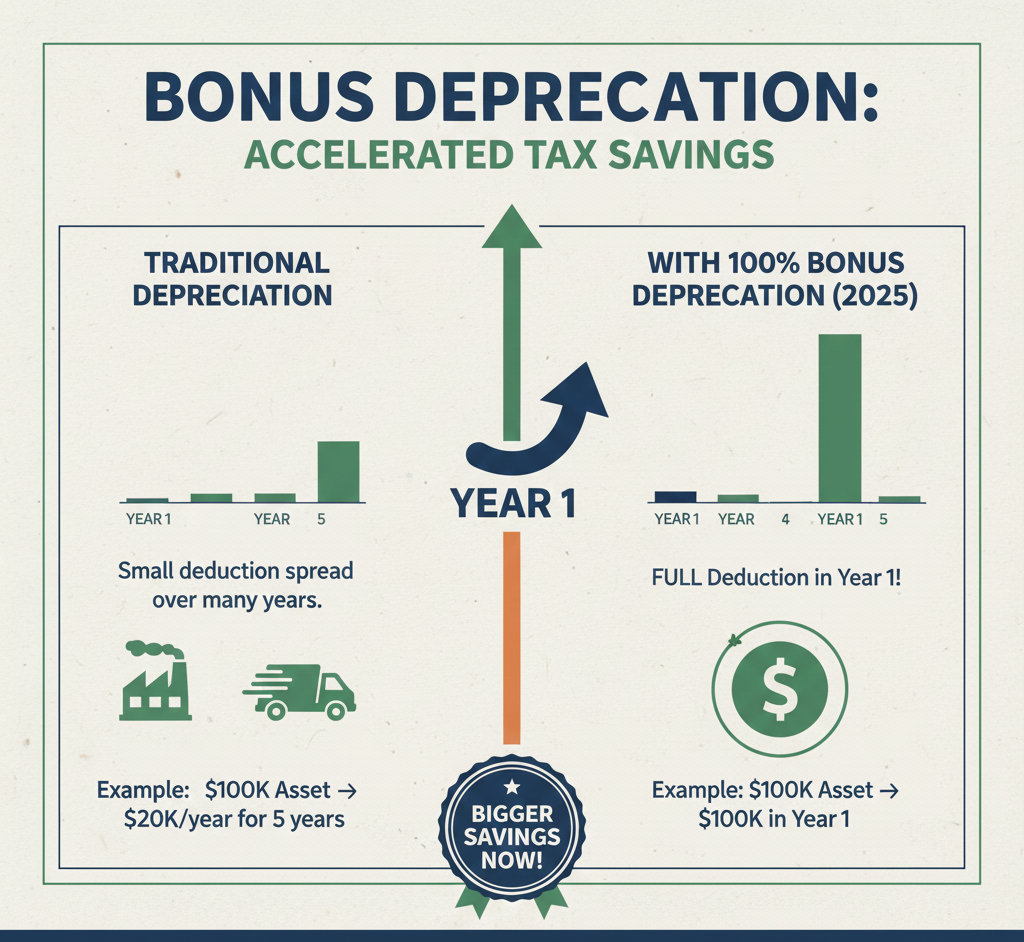
- You cannot take Section 179 or bonus depreciation in the year you buy or place the truck in service
- You cannot deduct the actual cost of that $8,000 wrap or $12,000 generator
- You’re stuck with this method for the entire life of the vehicle (or until you sell it)
When You SHOULD Use the 70¢ Standard Mileage Rate in 2025
Yes, there are still situations where standard mileage wins:
- Your truck is under 6,000 lbs GVWR (rare for food trucks—most Sprinter conversions are right at the line)
- You use the same vehicle heavily for personal trips (the IRS doesn’t prorate personal miles under standard method)
- You absolutely despise record-keeping and would rather leave a few thousand on the table
- You lease the truck and the lease is in your personal name (actual expenses get messy fast)
If any of those describe you, grab the 70¢ rate and sleep easy.
Everyone else? Keep reading.
Why Actual Expenses Crush Standard Mileage for Real Food Trucks
Once your combined truck + trailer exceeds 6,000 lbs GVWR (check the door jamb sticker), the IRS classifies it as “non-personal” use property. That unlocks a treasure chest:
- Deduct 100% of fuel, repairs, tires, wraps, insurance, tolls, parking tickets—literally everything
- Take Section 179 up to $1,250,000 in 2025 (plus 40% bonus depreciation on the rest)
- Deduct loan interest if you financed
- Still write off the business percentage of everything even if you drive home at night
Side-by-Side Comparison Table: 2025 Deductions (Same 28,000 Business Miles)
| Expense Category | Standard Mileage (70¢) | Actual Expenses Method | Winner |
|---|---|---|---|
| Mileage / Fuel + Repairs | $19,600 | $18,400 | Actual (close) |
| Section 179 / Bonus Depreciation | $0 | $54,000 (example truck) | Actual |
| Wrap + Generator + Equipment | $0 | $21,000 | Actual |
| Insurance + Registration | Included in 70¢ | $4,800 | Actual |
| Interest on Truck Loan | $0 | $3,200 | Actual |
| Total Deduction | $19,600 | $101,400 | Actual +$81,800 |
*Numbers based on real Orlando client; your results will vary.
Real Client Story: Orlando Taco Truck (2024 Numbers, Updated for 2025)
“Maria’s Tacos” – 2019 Freightliner MT55 step van + 24′ trailer GVWR: 25,999 lbs 2024 business miles: 28,000
Standard mileage method 28,000 × $0.67 (2024 rate) = $18,760 (2025 would be $19,600—still tiny)
Actual expense method (2024 actuals) Fuel: $16,800 Repairs & tires: $4,900 Insurance + registration: $4,800 Wrap refresh: $6,500 Generator service + propane: $2,200 Section 179 on new refrigeration upgrade: $12,000 Interest + depreciation: $8,000 Total actual deduction: $55,200
Tax savings at 32% bracket: extra $11,660 back just by switching methods.
Maria almost defaulted to standard mileage because “that’s what TurboTax told me to do.”
The 6,000-lb GVWR Rule You Must Know in 2025
This is the single most overlooked rule in mobile business taxation.
IRS Publication 463: Vehicles over 6,000 lbs GVWR are exempt from the luxury auto depreciation caps and qualify for full Section 179.
Common food trucks that clear the cutoff easily:
- Freightliner MT45/MT55
- Workhorse P42/P30
- Most 16–26 ft box trucks
- Any truck + loaded trailer combination over 6,000 lbs
Pro tip: Weigh your truck fully loaded (water, propane, inventory) at a CAT scale. Many “under 6,000 lb” Sprinters actually tip over when rigged for food service.
How to Switch from Standard Mileage to Actual Expenses
You only get one bite at the apple.
If you’ve been using standard mileage, you can switch to actual expenses in a later year, but you lose the remaining depreciation basis on the vehicle. That’s thousands left behind.
Best strategy:
- Year 1 (purchase year): Use actual expenses + max Section 179
- Every year after: Continue actual expenses
Never start with standard mileage on a heavy food truck unless you love giving the IRS gifts.
Frequently Asked Bonus Deductions with Actual Expenses
- That $12,000 vinyl wrap? 100% deductible as advertising
- Commercial auto insurance? Deduct every penny of the business percentage
- Parking tickets while serving customers? Yes, really (but fight them anyway)
- Tolls & E-ZPass for SunPass in Florida? All business
- Generator fuel & propane? Deduct it
Suggested Visuals for This Post
- Side-by-side deduction comparison table (above)
- Infographic: “Is Your Truck Over 6,000 lbs? Decision Tree”
- Before/after tax refund check photo (client-approved)
- Screenshot of Section 179 limits chart for 2025
Don’t Leave 2025 Money on the Table
The 70¢ standard mileage rate is a shiny trap for most food truck owners. Unless your rig is truly under 6,000 lbs and you hate paperwork, actual expenses will almost always put thousands—sometimes tens of thousands—back in your pocket.
Ready to run your own numbers?
Get your free 2025 Food Truck Tax Savings Assessment today. We’ll review your truck specs, 2024 return, and show you exactly how much you’re leaving behind—no cost, no pressure.
→ https://nexustaxbooks.com/assessment/
Or call us directly at (904) 385-0466 — we answer the phone.
Future Outlook: What’s Coming in 2026 and Beyond
The IRS has hinted that standard rates may climb again with fuel prices, but Section 179 limits are scheduled to drop after 2026 unless Congress acts. Locking in actual expenses now positions you to grab maximum deductions while they’re still generous.
Final Warning Before December 31, 2025
If you placed a new (or “new to you”) food truck in service in 2025 and you’re still planning to take standard mileage—you are about to make one of the most expensive mistakes of your business life.
Stop. Run the numbers. Talk to someone who actually understands heavy vehicles and mobile businesses.
We’ve saved our food truck clients an average of $18,400 per return by making this one switch.
Let 2025 be the year you keep more of what you earn.
One last time: Claim your free assessment before the year-end crunch. → https://nexustaxbooks.com/assessment/
You’ve built an amazing business on wheels. Now let’s make sure the IRS doesn’t eat your profits.
FAQ – Mileage vs. Actual Expenses 2025
1. Is the 2025 standard mileage rate really 70 cents? Yes—announced November 2024. The official rate for business use January 1 through December 31, 2025 is 70 cents per mile. Medical/moving is 21 cents; charity remains 14 cents.
2. Can I use standard mileage for part of the year and actual expenses for the rest? No. IRS rules require you to use the same method for the entire tax year for that specific vehicle. Pick one and stick with it for 2025.
3. My food truck is exactly 6,000 lbs GVWR—standard or actual? The cutoff is over 6,000 lbs to escape luxury-auto rules. At exactly 6,000 you’re still capped. One pound over changes everything.
4. I used standard mileage in 2024—can I switch in 2025? Yes, but you forfeit the remaining depreciable basis. For most food trucks purchased in the last 3–5 years, this is a five-figure mistake. Run the math first.
5. Do I still need a mileage log if I use actual expenses? Yes! You must prove the business percentage (usually 90–100% for food trucks). Contemporaneous logs are still your best protection in an audit.
Phone: (904) 385-0466 Email: info@nexustaxbooks.com https://nexustaxbooks.com/