

Did you know that according to a recent QuickBooks report, over 60% of self-employed real estate professionals overpay their taxes by an average of $3,200 annually due to overlooked deductions? As a Realtor hustling through open houses and client meetings, the last thing you need is the IRS taking a bigger bite out of your hard-earned commissions. In this comprehensive guide to top deductions for Realtors and real estate professionals, we’ll uncover actionable strategies to slash your tax bill legally and efficiently.
Whether you’re a solo agent closing deals from your home office or a broker managing a team, mastering these deductions can transform your financial game. We’ll dive into key perks like the home office deduction 2025, mileage tracking for endless showings, and marketing must-haves. Plus, we’ll address real estate professional status benefits for investment properties and share tax tips for real estate investors 2025. By the end, you’ll have a roadmap to keep more of your income—stick around for our exclusive FAQ and pro tips tailored for solopreneurs in the field.
Why Top Deductions for Realtors and Real Estate Professionals Matter in 2025
The 2025 tax landscape brings fresh opportunities and tweaks from the IRS, including restored 100% bonus depreciation under recent reforms. For realtors, who often operate as independent contractors, these deductions aren’t just nice-to-haves—they’re essential for offsetting the volatility of commission-based income. According to IRS Publication 535, business expenses directly reduce your taxable income, potentially dropping you into a lower bracket.
Imagine reclaiming thousands on everyday costs like gas for client drives or software for virtual tours. But beware: the IRS scrutinizes self-employed filers more closely in 2025, with audits up 15% for Schedule C users per recent agency stats. Proper documentation is your shield. In this section, we’ll break down why prioritizing top deductions for Realtors and real estate professionals builds long-term wealth, especially amid rising property values and market shifts.
- Boost Cash Flow: Deducting vehicle expenses alone can save agents $1,500–$4,000 yearly, freeing up funds for marketing or retirement.
- IRS Compliance: Align with updated rules on qualified business income (QBI) deductions, now permanent at up to 20% under the 2025 Tax Act.
- Competitive Edge: Savvy pros use savings to invest in tools, outpacing peers who overlook these perks.
Ready to optimize? Explore our tax planning services at Nexus Tax Books for personalized strategies.
Home Office Deduction 2025: A Game-Changer for Remote Realtors
The home office deduction 2025 remains a cornerstone for real estate pros blending work and home life. Under IRS rules, you can deduct a portion of your housing costs if your space is used exclusively and regularly for business—like prepping listings or hosting Zoom closings. For 2025, the simplified method caps at $5 per square foot (up to 300 sq ft), but the actual expense method often yields bigger savings by factoring in mortgage interest, utilities, and repairs.
Why does this matter now? With hybrid work here to stay, QuickBooks data shows 45% more agents claiming this deduction post-pandemic, averaging $1,200 in refunds. Calculate your eligible space: measure the room’s square footage and divide by your home’s total to get the business percentage. Apply that to prorated bills—easy with apps like Expensify.
Qualifying for Home Office Deduction
To qualify:
- Exclusive Use: No personal activities in the space—think dedicated desk, not your kitchen table.
- Regular Use: Consistent business activity, proven by calendars or logs.
- Principal Place: It must be your main office or where you meet clients.
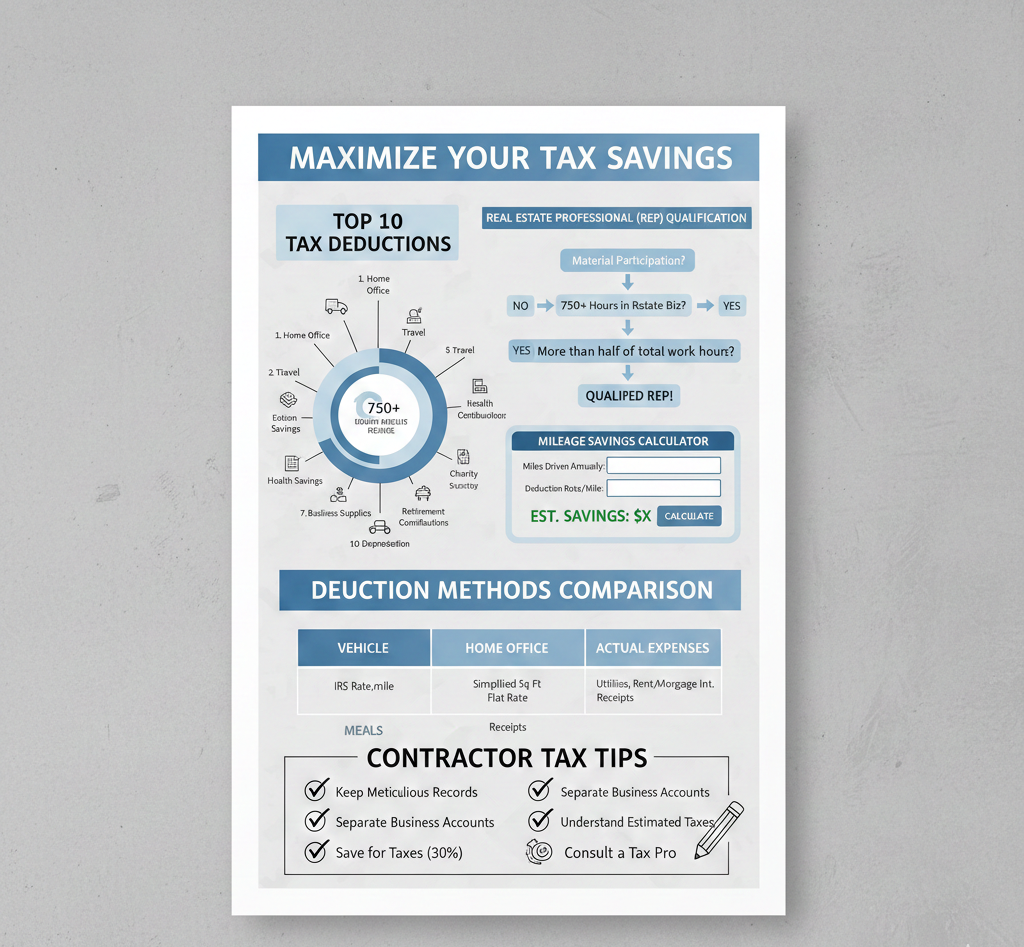
| Deduction Method | Pros | Cons | Estimated Savings (1,000 sq ft home, 100 sq ft office) |
|---|---|---|---|
| Simplified ($5/sq ft) | Easy math, no records needed | Lower max ($1,500) | $500 |
| Actual Expenses | Higher potential (e.g., $2,000+ on utilities) | Requires receipts | $1,200+ |
Pro tip: If you’re a solopreneur, layer this with QBI for double dips. Schedule a free tax assessment today to crunch your numbers—call (904) 385-0466.
This deduction isn’t just savings; it’s validation of your grind. Many agents undervalue it, but in 2025’s high-cost environment, it’s a must-claim.
Mileage Deduction for Real Estate Agents: Fueling Your Tax Savings
Driving from suburb to city for showings? The mileage deduction for real estate agents turns those miles into money back in your pocket. For 2025, the IRS standard rate jumps to 68 cents per mile—up from 2024’s 67 cents—covering gas, maintenance, and depreciation without itemizing.
Real estate pros log an average 25,000 business miles yearly, per NAR stats, equating to $17,000 in deductions. Track via apps like MileIQ, which auto-categorizes drives. Remember: commutes don’t count, but client errands do. If your vehicle is over 50% business-use, consider actual expenses like lease payments for potentially higher write-offs.
Tracking Mileage Like a Pro
Follow these steps:
- Log Everything: Start odometer readings January 1; note purpose (e.g., “Open house at 123 Main St.”).
- Separate Personal: Use a dedicated app to filter non-business trips.
- Audit-Proof: Keep GPS data for three years—IRS loves substantiation.
QuickBooks reports that diligent trackers reclaim 20% more than guessers. For contractors juggling flips and sales, this pairs perfectly with equipment deductions. Don’t let fuel costs drain you—link your QuickBooks to our bookkeeping tools for seamless integration.
2025 Mileage Tax Savings Calculator
See how much you could save with the IRS standard rate of 70¢ per mile
In a market where time on the road equals revenue, this deduction keeps your engine—and wallet—running smoothly.
Marketing Deductions for Realtors: Advertising Your Way to Lower Taxes
Staging homes, printing flyers, or boosting social ads? Marketing deductions for Realtors let you write off 100% of costs that drum up business. From headshots ($200–$500) to CRM software ($50/month), these expenses directly tie to client acquisition.
In 2025, with digital marketing spend up 25% per Inman reports, agents average $8,000 annually on promotions—fully deductible if ordinary and necessary. Website hosting? Yes. Branded swag for open houses? Absolutely. The key: allocate only business portions, like 80% of a phone bill used for leads.
Maximizing Marketing Write-Offs
- Digital Tools: SEO services, email platforms (e.g., Mailchimp)—deduct subscriptions fully.
- Print & Events: Business cards, signage, networking fees—receipts make it IRS-proof.
- Content Creation: Photography, videography for listings—capitalize big here.
A table of common costs:
| Marketing Item | Average Cost | Deductible Portion | Potential Savings (37% Bracket) |
|---|---|---|---|
| Social Ads | $2,000/year | 100% | $740 |
| Photography | $300/shoot | 100% | $111 |
| CRM Software | $600/year | 100% | $222 |
Overlooked marketing claims cost agents $1,000+ in refunds. As a food truck owner moonlighting in flips? Apply the same to promo vehicles. Get expert advice via email at info@nexustaxbooks.com to audit your spends.
These deductions fuel growth—spend smart, save smarter.
Real Estate Professional Status Benefits: Unlocking Investment Perks
Qualifying as a real estate professional status benefits holder flips passive rental losses into active offsets against your W-2 or commission income. Under IRS Section 469, you must spend 750+ hours yearly on real estate trades (more than half your work time) and materially participate in each property.
For 2025, this status dodges the 3.8% Net Investment Income Tax (NIIT) on rentals, per updated Pub 925. Cherry Bekaert notes it saves qualifying pros $10,000+ by allowing full loss deductions—vital in volatile markets.
Proving Your REP Status
Document with:
- Time Logs: Calendars showing hours on development, management, or brokerage.
- Spousal Loophole: If married, one spouse qualifying covers joint returns.
- Aggregation: Group properties to meet participation tests.
Benefits include accelerated depreciation and QBI boosts.
This isn't for casual landlords—it's for pros like you. Dive deeper in our REP guide.
Handling Real Estate Investment Property Income as a Real Estate Professional
As a REP, tax tips for real estate investors 2025 shift how you handle investment property income—from passive to non-passive. Rental profits now qualify as active, letting losses offset non-real estate income without $25,000 passive loss limits.
Key: Material participation (500+ hours/property or 100+ if substantial). IRS 2025 rules emphasize logs; audits rose 12% for REP claims. Use cost segregation for bonus depreciation on components like HVAC—100% deductible upfront.
Bold Sub-KW: Income Strategies for REP Investors
- Depreciation Recapture: Plan sales with 1031 exchanges to defer gains.
- QBI Deduction: Up to 20% off net rental income—stack with REP perks.
- Self-Rental Rules: Income from leasing to your brokerage? Treat as non-passive.
| Scenario | Without REP | With REP Status | Savings Example |
|---|---|---|---|
| $20K Rental Loss | Suspended | Offset Salary | $7,400 (37% tax) |
| $50K Rental Income | NIIT 3.8% | No NIIT | $1,900 |
QuickBooks advises grouping activities for easier compliance. For contractors flipping properties, this means deducting rehab costs against rentals. Visual Suggestion: Flowchart for REP income flow.
Maximize by year-end—book a consultation at https://nexustaxbooks.com/consult.
Education and Professional Fees: Investing in Your Expertise
Continuing education keeps your license sharp—and deductible. Tax tips for solopreneurs like realtors include writing off NAR dues ($150/year), MLS fees ($500+), and courses ($200–$1,000).
2025 IRS guidelines allow 100% for fees enhancing skills. Track via statements; average savings: $800, per FreshBooks.
Deductible Learning Costs
- Licensing: Renewal fees, exams.
- Conferences: Travel to NAR events (mileage + lodging).
- Subscriptions: Trade mags, online portals.
These build trust with clients while trimming taxes. As a solopreneur, bundle with home office for synergy.
Additional Tax Tips for Contractors in Real Estate 2025
Contractors handling rehabs? Deduct tools, subcontractors, and materials fully. 2025 brings extended Section 179 for equipment up to $1.2M. Pay quarterly estimates to avoid penalties—QuickBooks estimates 40% miss this, accruing 5% underpayment fees.
- Retirement Boosts: SEP-IRA contributions up to 25% of income.
- Health Insurance: 100% self-employed deduction.
- SALT Cap: Workarounds via pass-through entities.
Claim your free 2025 tax checklist.
Wrapping Up: Secure Your Savings Today
From home office deduction 2025 to mastering real estate professional status benefits, these top deductions for Realtors and real estate professionals empower you to thrive amid 2025's changes—like permanent QBI and bonus depreciation. We've covered mileage, marketing, investments, and tips for solopreneurs and contractors, backed by IRS data.
Looking ahead, expect tighter audits but richer incentives for active pros. Don't overpay—average savings could hit $5,000+. Ready to act? Get your free assessment at nexus taxbooks.com/assessment/ or call (904) 385-0466. Your future self (and bottom line) will thank you.
FAQ
What qualifies me as a real estate professional in 2025?
To claim real estate professional status benefits, you need over 750 hours in real estate activities annually, comprising more than 50% of your total work time, plus material participation in each rental. Document with detailed logs—calendars, apps like Toggl. Spouses can qualify jointly. Benefits include offsetting losses against salary, avoiding NIIT, and full depreciation. IRS audits focus on proof; consult a pro to avoid pitfalls. Per Pub 925, this status turns passive income active, saving thousands. (78 words)
How do I calculate the home office deduction 2025 for my realtor business?
Measure your exclusive workspace square footage, then use the simplified method ($5/sq ft, max $1,500) or actual expenses (prorate rent/utilities by business percentage). For a 200 sq ft office in a 2,000 sq ft home, that's 10% of $24,000 annual costs = $2,400 deduction. Track with photos/receipts. QuickBooks notes 30% more claims in 2025 due to remote trends. Avoid mixing personal use to stay IRS-compliant.
Can I deduct marketing expenses if I'm a part-time real estate agent?
Yes, marketing deductions for Realtors apply proportionally—even part-time. Deduct 100% of business-tied costs like ads or flyers. If 60% of your time is real estate, prorate shared items. Keep invoices; average part-timer saves $600/year. 2025 rules emphasize "ordinary and necessary"—social boosts qualify. For solopreneurs, this pairs with QBI. Track via categories in QuickBooks for easy filing.
How does REP status affect my investment property income taxes?
As a REP, rental income becomes non-passive, allowing losses to offset other earnings without limits. Deduct full depreciation, repairs—use cost seg for 100% bonus on assets. Avoid 3.8% NIIT; apply 20% QBI. 2025 reforms enhance this via permanent provisions. Log participation hours meticulously. Anomalycpa.com estimates $15K+ savings for multi-property owners. Group activities for flexibility.
What are quick tax tips for contractors in real estate for 2025?
Pay quarterly estimates to dodge penalties; deduct tools/materials under Section 179 ($1.2M limit). Use REP if qualifying for loss offsets. Track mileage at 68¢/mile; contribute to SEP-IRAs for 25% income deferral. QuickBooks warns of 25% overpayment risk—categorize expenses now. Health insurance? Fully deductible. Bundle with marketing for flips. Stay audit-ready with digital receipts.